
Addressing poverty where it counts, for those it impacts most


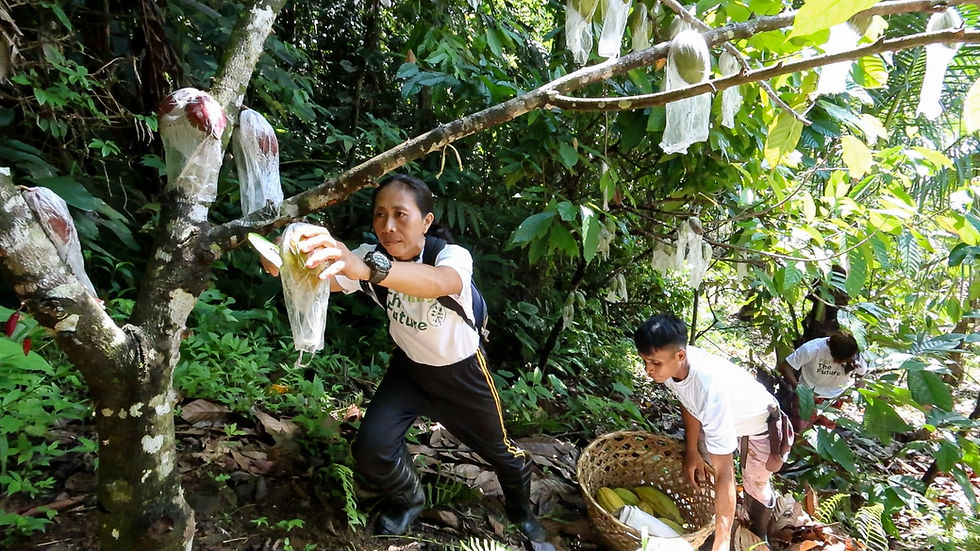
A cacao farmer conducting a pruning and sanitation activity to rehabilitate his farm.
Nearly 50% of the Philippine population self-identify as poor, with around 10% experiencing involuntary hunger (SWS, 2023). According to the Philippine Statistics Authority (PSA), farmers and fishers are the groups most severely affected by extreme poverty, with a poverty incidence rate of 30%. This rate is almost double the national average (18.1%) and more than triple the global poverty rate (8.8%), as reported by the World Bank (Worldbank, 2023a).
The precarious situation of farmers and fishers highlights the urgent need to take immediate action to ensure food security and stability. Farmers confront a multitude of challenges, with the most critical barriers including limited access to capital, insufficient or scarce post-harvest and treatment facilities, the impact of extreme weather conditions due to climate change, restricted access to markets, and a lack of innovative practices. Addressing these barriers is crucial to improving the livelihoods of these key contributors to the nation's food supply.
A strategic focus should be centered on targeting farmers and fishers living in extreme poverty, particularly in Mindanao where 70% of those who self-identified as poor are located (SWS, 2023). With limited resources to address poverty, it is crucial to allocate efforts to enact ambitious interventions, particularly in areas where the potential for impact is significant. This need for developmental support in Mindanao is a persistent issue, reflecting broader challenges in the Southern Philippines. The area's enduring cultural, religious, and armed conflicts are largely attributed to a scarcity of economic opportunities, which fuels a relentless cycle of poverty (Asia Society Philippines, 2018). The most recent report by Asian Affairs highlights this issue, noting that among the Top 10 poorest provinces in the Philippines, seven are located in Mindanao (Lanao del Sur, Maguindanao, Sarangani, Sulu, Zamboanga del Norte, Sultan Kudarat, Agusan del Sur), and three are in the Visayas (Northern Samar, Siquijor, Western Samar).
Acknowledging the situation in Mindanao and pinpointing the groups most impacted by extreme poverty and channeling strategic efforts into this region can render an ambitious poverty reduction plan viable. This targeted approach has the potential to significantly influence the lives of farmers and fishers, particularly when resources are allocated efficiently, ensuring that the impact is both profound and sustainable.
The approach must be aimed at efficient resource allocation, optimizing limited resources and capacities to positively impact farmers and fishers socio-economic conditions. There's a crucial need for a fundamental shift in how poverty is addressed strategically, as the status quo has proven insufficient. This is evidenced by the continued struggles against hunger and malnutrition that are directly attributable to poverty.
Poverty is a complex, multifaceted and multidimensional problem, and thus reducing it requires a holistic and ecosystem-based perspective. The approach to addressing poverty should be comprehensive, addressing the multiple dimensions of poverty, both physical and socio-economic, and seeking to tackle its root causes through integrated interventions (Acker et al., 2009; Cardona, 2013). The creation of an enabling environment is crucial, and the implementation of market-driven programs with farmers and fishers, along with complimentary programs such as on Health, Child Nutrition, Education, Entrepreneurship and Resiliency are core to its success. A key element as well is the ability to rally other development stakeholders and actors with relevant programs, resources or expertise to address the complex and multifaceted problem on poverty and contribute to the value creation process (Acs et al., 2017).
Interventions should also be grounded in co-creation, prioritizing the involvement of the community in planning and decision-making, and adhering to a bottom-up approach that empowers the farmers and fishers. This emphasizes grassroots participation and local leadership, enabling tailored solutions to community needs. As mentioned, the interventions should be market-driven, aligning agricultural production to what are the opportunities in the market in order to enhance profitability of farming initiatives which subsequently can create jobs and drive local economy (Prahalad et al., 2002).

Kapunungan sa Gagmay’ng Mangingisda sa Concepcion (KGMC) fishers harvesting live grouper.
Farmers and fishers, despite playing a critical role in ensuring food security, are among the most affected by poverty and have often been overlooked by broader segments of society. While numerous NGOs and CSR projects engage in development work and assistance to the impoverished, the war on poverty is far from won, as initiatives often fall short in ambition and scale.
The deeply rooted poverty in the Philippines may appear insurmountable, yet there is hope for mitigating it through the introduction of well-designed and executed interventions that empower stakeholders to co-create solutions. Reducing poverty is an ambitious endeavor, but with a “depth of intention”, it is possible.
This article is part 1/3 of a series on Poverty Alleviation, written by Josh Mahinay, a social entrepreneur involved in various enterprises and social impact initiatives in the Philippines. His interest in business for social good inspired him to pursue entrepreneurial and social innovation studies at the Asian Institute of Management (AIM) in Manila and at the London School of Economics and Political Science (LSE) in London.


trang chủ pg99 dạo này mình thấy có người nhắc tới khi nói về các nền tảng giải trí trực tuyến nên cũng thử mở vào xem cách họ bố trí giao diện ra sao. Mình không đi sâu vào nội dung hay từng trò cụ thể, mà chủ yếu quan sát cách các chuyên mục được phân chia trên trang và cách thông tin hiển thị cho người dùng. Nhìn tổng thể thì các khu như thể thao, casino, game bài hay slot thường được sắp xếp theo từng nhóm khá rõ, hiển thị dạng khối và danh sách nên lướt qua cũng dễ theo dõi. Các bảng dữ liệu được trình bày dạng cột khá gọn, giúp quan…
vipwinmobile com lúc đầu mình cũng hơi ngại bấm vào, sợ kiểu trang rối rắm với chữ nghĩa loạn lên. Nhưng mở ra rồi thì thấy cách họ đặt các khối nội dung khá ổn, nhìn lướt là hiểu chỗ nào là phần chính, chỗ nào là thông tin giới thiệu, không bị dồn một cục; mình để ý mấy tiêu đề kiểu “Giới Thiệu Thương Hiệu” với phần cam kết bảo mật được đưa lên rõ ràng nên đọc nhanh cũng nắm được ý. Trải nghiệm kéo qua lại trên điện thoại cũng mượt, menu nằm chỗ dễ nhìn nên chuyển mục không mất công tìm, cảm giác họ ưu tiên người dùng hơn là nhồi nhét. Nói chung…
https://gamebaidoithuong.capital/ban-ca/ Đọc cái chủ đề “top 10 bắn cá online tháng 9/2026” nghe hơi nghiêm túc như bài kiểm tra cuối kỳ, mà lạ là lướt lại không bị ngợp. Mình vào kiểu xem cho vui thôi, nhưng tiêu đề “top 10” đặt ngay trên đầu trang nên định hướng rõ ràng, không cần đoán họ đang nói gì. Nội dung chia theo từng khối ngắn, mắt cứ trượt xuống là bắt được ý, đỡ phải bơi trong một đống chữ. Có chỗ họ ghi mấy con số cụ thể như mức đạn từ 100 tới 50.000 xu, nhìn phát hiểu ngay tệp người chơi nhắm tới là ai. Nói chung trang này hợp cho ai thích xem nhanh. Phần…
SUN WIN nghe cái chủ đề “Trang Chủ Chính Thức… 2026” là mình yên tâm hơn chút, vì ít nhất họ nói rõ đang hướng tới cái gì. Mình vào thử với tâm thế xem giao diện có dễ chịu không thôi, chứ cũng không định đọc kỹ hay mò mẫm gì nhiều. Trang dùng nền sáng nên nhìn lâu không bị mỏi mắt, chữ cũng vừa tầm, không bị dồn dập. Mấy phần nội dung được đặt thành từng khối gọn gàng nên lướt một vòng là nắm được bố cục. Có cái menu để ngay chỗ dễ thấy, bấm qua lại giữa các mục không bị lạc hay phải tìm quanh. Nói chung cảm giác trang làm đơn…
https://ae888.cat/ mình ghé thử vì thấy bạn bè nói qua, kiểu vào xem giao diện có dễ dùng không thôi. Ấn tượng đầu là trang nhìn khá thoáng, chia mục rõ ràng nên lướt nhanh vẫn không bị rối mắt. Mình có thấy họ nhắc nền tảng hỗ trợ cả web lẫn điện thoại (Android/iOS), nên mình thử mở trên màn hình nhỏ thì bố cục vẫn ổn, chữ không bị vỡ hay dồn cục. Không đọc kỹ nội dung, chỉ để ý cách họ trình bày thông tin: tiêu đề tách thành từng khối riêng, nhìn phát biết đang ở phần nào. Menu đặt khá dễ thấy, bấm qua lại mượt, và các heading được đóng khung theo block…